
Industrial Vacuum Heat Treatment Furnace for Tool Steel Processing
August 11, 2026
When your tool steel components demand flawless surface integrity and predictable mechanical properties, an Industrial Vacuum Heat Treatment Furnace becomes an essential solution. This specialized metallurgical equipment creates a controlled vacuum environment where tool steels undergo thermal transformation without oxidation or decarburisation. By removing atmospheric oxygen and reactive gases during heating cycles up to 1300°C, vacuum heat treatment ensures your precision components achieve exceptional hardness, wear resistance, and dimensional stability—critical factors for automotive tooling, aerospace components, and high-performance die manufacturing.
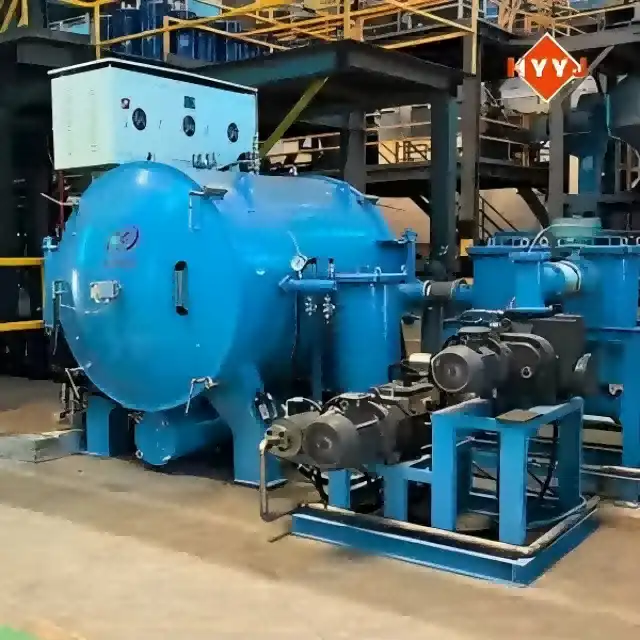
Understanding Industrial Vacuum Heat Treatment Furnaces
Creating sub-atmospheric pressure conditions that stop surface degradation during thermal processing is at the heart of Industrial Vacuum Heat Treatment Furnace technology. In contrast to conventional atmospheric furnaces, which require protective gas mixtures, vacuum systems evacuate the chamber to as low as 6.7×10⁻² Pa. This environment removes all oxygen molecules that would normally react with steel surfaces when heated.
How Vacuum Pressure Eliminates Oxidation
When metals are heated in the usual way, iron and alloying elements react with oxygen in the air to make scale layers that need to be removed in expensive ways. This problem is completely solved by our Industrial Vacuum Heat Treatment Furnace solutions at Heyuanxin. Because there are no reacting gases, the surfaces of your tool steel will come out of the heat cycle with a smooth, bright finish that doesn't need to be ground or polished again. This directly means lower production costs and faster turnaround times for your business.
Batch Versus Continuous Furnace Configurations
Tool steel processors usually have two main types of furnaces to choose from. Batch systems are very adaptable and can handle a wide range of task sizes and steel types. The chamber sizes can be changed to fit any needs, ranging from 400x400x600mm to 1200x1200x1800mm. When processing different part geometries or when production volumes change with the seasons, these units work great. For high-volume producers working with standard parts, continuous furnaces are the best option, as they ensure steady throughput for repeated production runs. Your choice depends on your annual production volume, the types of parts you need, and the floor space available.
Three-Stage Process Methodology
The steps in the Industrial Vacuum Heat Treatment Furnace process are obvious. During the heating phase, resistive elements, which are usually made of molybdenum or graphite, slowly raise the temperature of the chamber while vacuum pumps keep the pressure low. Next is the soaking stage, where the temperature stays stable within ±1°C so that the microstructural change is the same across the whole batch. During the controlled cooling process, inert gases like argon or nitrogen are added at measured rates. This makes sure that the hardness profile you need is met. This methodical approach gives consistent metallurgical results from one batch to the next.
Advantages of Vacuum Heat Treatment Furnace in Tool Steel Processing
When metallurgical companies switch from traditional atmosphere furnaces to Industrial Vacuum Heat Treatment Furnace technology, they find that their machines work much better. The differences go beyond the quality of the surface and include things like mechanical properties, how well they work, and how well they comply with environmental laws.
Enhanced Surface Quality and Mechanical Properties
When your tool steel parts come out of the Industrial Vacuum Heat Treatment Furnace cycle, their surfaces are spotless and don't have any metal scale or decarburisation on them. This maintains the full hardness potential of high-speed steels and hot-work tool steels by preserving the surface carbon content. We have proof that M2 high-speed steel treated in vacuum systems had a surface hardness of 64–65 HRC compared to 60–62 HRC from atmosphere furnaces. This is a big benefit for cutting tool users. Even warmth in vacuum chambers gets rid of soft spots that shorten the life of tools.
Energy Efficiency and Environmental Compliance
Newer Industrial Vacuum Heat Treatment Furnaces use a lot less energy than older atmosphere furnaces that needed a steady flow of protective gas. Our two-layer water cooling system recovers heat energy and keeps the temperature exactly where it should be. Getting rid of cooling oils gets rid of fire risks and the need to treat wastewater, which brings your operations in line with stricter environmental rules. This process is very helpful for businesses that work with metal in California and other regulated areas to keep their operating permits.
Operational Safety and Maintenance Protocols
Multiple safety systems are built into industrial vacuum heat treatment. Furnace technology protects both people and parts. Keeping an eye on the vacuum degree makes sure that the working conditions are perfect during the whole heating cycle. Over-temperature alarms stop thermal runaway, which could damage expensive tools. Over-pressure protection keeps the operating conditions safe if cooling gas is added too quickly. For specialised processes lasting more than 24 hours, the extended vacuum holding feature keeps the processing conditions stable. Routine maintenance includes simple tasks like servicing the vacuum pump, calibrating the thermocouple, and checking the heating element. If done on time, these tasks will ensure the most uptime.

Comparing Vacuum Heat Treatment Furnaces to Other Solutions for Tool Steel
When purchasing managers look at big purchases like capital equipment, it's helpful to know how Industrial Vacuum Heat Treatment Furnaces stack up against other heat treatment methods. To make the choice, you have to weigh the initial costs against the long-term performance and operational expenses.
Performance Metrics Against Atmosphere Furnaces
Standard atmosphere furnaces that use endothermic gases or mixtures of nitrogen and methanol cost less at first, but they cost more in the long run because they need protective gases and cleaning after treatment. When working with reactive metals like titanium or precipitation-hardening stainless steels that need to be completely free of air, these systems have trouble. When you use an Industrial Vacuum Heat Treatment Furnace, you don't have to pay for gas, and they work better on tough materials. The trade-off is a bigger initial investment, but you offset this with lower ongoing costs and more working power.
Gas Quenching Versus Oil Quenching Considerations
Traditional oil quenching cools things down quickly, which is needed for through-hardening thick sections, but it also needs to be cleaned up afterward and can cause fires. In Industrial Vacuum Heat Treatment Furnaces, gas quenching systems use up to 20 bar of high-pressure neutral gas to cool at speeds close to oil quench speeds without contaminating the gas. Because gas quenching doesn't warp as much as liquid quenching, your complicated die shapes stay within their dimensions. Gas cooling works best for tool steels like D2 or A2 that can be hardened easily.
Evaluating Major Equipment Manufacturers
Leading Industrial Vacuum Heat Treatment Furnace suppliers use different kinds of technology. People all over North America know that Ipsen systems last a long time and have large service networks. ALD technology has advanced control systems that can precisely control the partial pressure for special metals. SECO/WARWICK offers modular designs that make it easy to add more capacity in the future. Quintus specialises in high-pressure cooling devices that must work in difficult conditions. Heyuanxin has shipped more than 400 furnace systems around the world since 2003, offering low prices and full expert support. Our team of 11 senior experts and experienced steel professionals helps with installation and quickly resolves problems so that production stops as little as possible.
How to Choose the Right Industrial Vacuum Heat Treatment Furnace for Tool Steel?
To choose tools that will work well for your business for decades, you need to carefully look at technical specs and the Industrial Vacuum Heat Treatment Furnace supplier's abilities. Making the wrong choice leads to delays and poor quality, while making the right choice improves your position in the market.
Defining Your Capacity and Processing Requirements
To start, figure out how much tool steel is processed each year and what the largest part can be. A 600x600x900mm chamber can hold most injection mould parts and precision dies, while a 1200x1200x1800mm chamber is better suited for stamping dies and aerospace structural parts. The temperature must be able to handle the types of steel you are using. For example, 1300°C can handle high-speed steels and nickel alloys, but many tool steels can be processed successfully at 1100°C. Labour costs and batch consistency are affected by the level of automation. Fully automated systems with customisable plans make operators less necessary, but they are more expensive to set up initially.
Evaluating Total Cost of Ownership
Calculate how much electricity you will use based on your Industrial Vacuum Heat Treatment Furnace processing plan, not just the buy price. Maintenance on the vacuum pump is the most expensive ongoing cost. It should be serviced once a year and rebuilt every 3–5 years, based on how often it is used. Different types of heating elements need to be replaced at different times. In heavy-use areas, graphite elements tend to last longer than molybdenum ones. Under AMS 2750 temperature consistency standards, the thermocouple must be replaced every year. Include these costs in your estimates of return on investment (ROI), along with the benefits of better quality and lower scrap rates.
Supplier Credentials and Support Services
Check to see if the potential Industrial Vacuum Heat Treatment Furnace provider has the ISO 9001 quality management certification and any other environmental certifications that are needed. Heyuanxin has a 3A-level credit enterprise status, an ISO quality management system certification, an environmental management system certification, and an occupational health management system certification. These qualifications show that you are dedicated to maintaining high standards for making them. Support for installation, programs to train operators, and quick professional help are all just as important. Our one-stop service includes everything from design advice to commissioning and ongoing support for maintenance. The warranty should cover heating elements, vacuum parts, and control systems for a clear amount of time.
Customization and Production Line Integration
Standard Industrial Vacuum Heat Treatment Furnace layouts work well for many uses, but if you need to change something, please let us know. We can change the size of the chamber to fit your needs and make special fixtures for parts with odd shapes. Integration with existing systems for moving materials, like overhead cranes or automated loading systems, makes sure that work flows smoothly. Think about whether your business would be better off with a single big furnace or several smaller ones to allow for more output options. Talking about these things with expert suppliers like Heyuanxin can help you find the best setup for your needs.
Practical Applications and Case Studies in Tool Steel Processing
Examples from real life show how Industrial Vacuum Heat Treatment Furnace technology can be used to solve specific industrial problems in a wide range of fields. These examples show the usefulness that goes beyond technical details.
Automotive Tooling Applications
Stamping dies used to make body panels need to be very tough and resistant to wear. When D2 tool steel is heated in Industrial Vacuum Heat Treatment Furnaces, it makes all of the complicated die parts the same hardness. There are no soft spots that cause the steel to break too soon. A stamping plant in the Midwest switched to vacuum processing, which increased the life of its dies by 40% and eliminated the need to redo work due to dimensional distortion. The consistent results let them make stamped parts with tighter tolerances, which improved the quality of assembly for their automotive customers.
Aerospace Component Manufacturing
To meet safety standards, landing gear parts made from 300M ultra-high-strength steel need to have exact mechanical qualities. Industrial Vacuum Heat Treatment Furnace cycles stop surface decarburisation, which would lower wear resistance in applications that are loaded and unloaded many times. Jet engine turbine discs made of Inconel superalloys go through solution treating and ageing cycles in vacuum furnaces. This process stops the formation of alpha-case, which creates crack start sites. These important uses show why aerospace companies ask for vacuum processing on hardware that is used in flights.
Precision Die Manufacturing for Medical Devices
Surgical instrument makers need tool steels that don't rust and have surfaces that are safe for living things. When you use an Industrial Vacuum Heat Treatment Furnace to braze carbide inserts to steel bodies, you get clean joints with no flux leftovers. Bright annealing is helpful for injection moulds that make housings for medical devices because it eliminates the need for cleaning after treatment, which is a big plus when regulatory compliance depends on cleanliness. These unique uses show that vacuum heat treatment serves more than just standard tools.
Emerging Technology Trends
Digital control systems can now keep an eye on industrial vacuum heat treatment. Furnace vacuum levels, temperature uniformity, and cooling rates in real time, and they can also log data for good documentation. Technologies that save energy, like recuperative heat exchangers, cut the amount of electricity used by 15 to 20 per cent compared to older designs. Predictive maintenance algorithms look at data about how well vacuum pumps work to set up maintenance before they break down, which increases the availability of equipment. Companies that work with metals and invest in high-tech systems will benefit when Industry 4.0 connectivity becomes standard in manufacturing.
Conclusion
Industrial Vacuum Heat Treatment Furnace technology has been shown to work for tool steel processors who want high-quality and efficient operations. When you remove rust and decarburisation and precisely control the temperature, you achieve mechanical qualities that regular-atmosphere furnaces cannot match. Even though the initial investment is higher than for standard equipment, the total cost of ownership benefits, such as not having to do any post-processing, longer tool life, and lower scrap rates, make the investment worth it for mining plants that want to be the best in their field. To choose the right furnace, you need to carefully look at your working needs, the supplier's skills, and the availability of long-term support services. Companies like Heyuanxin have the technical know-how and full-service support you need to get the most out of your investment in vacuum heat treatment.
FAQ
What Temperature Range Works Best for Tool Steel Treatment?
Depending on the grade, Industrial Vacuum Heat Treatment Furnace processing occurs between 950°C and 1200°C for heat treatment. To fully dissolve carbides, high-speed steels like M2 and T15 need temperatures close to 1200°C, while hot-work steels like H13 can be worked well at temperatures between 1020°C and 1040°C. Our furnaces can handle temperatures from room temperature to 1300°C, so they can handle all the different grades of tool steel that your operations might use.
How Does a Vacuum Environment Extend Tool Steel Lifespan?
The carbon-rich top layer that is needed for maximum hardness is kept during Industrial Vacuum Heat Treatment Furnace processing. When steel is heated in the atmosphere, carbon can move off the surface and form a soft layer that goes away quickly in use. Vacuum treatment maintains full surface hardness throughout the cross-section of the component by preventing decarburisation. This directly increases service life by 30–50% in cutting and making applications.
What Maintenance Keeps Furnace Performance Reliable?
Every three months, quality tests of industrial vacuum heat treatment furnace temperature make sure that the heating is the same all over the work area. When you change the oil in your vacuum pump at the times suggested by the maker, you stop contamination from building up and slowing it down. Calibration of the thermocouple against known standards makes sure that the temperature is controlled correctly. Inspection of the heating element finds wear and tear before it breaks. When combined with proper operator training, these routine practices keep processing results consistent, and equipment lasts as long as possible.
Partner with Shaanxi Heyuan for Advanced Vacuum Heat Treatment Solutions
Shaanxi Heyuan is ready to help you handle your tool steel needs with their tried-and-true Industrial Vacuum Heat Treatment Furnace technology and excellent customer service. As a manufacturer with over 400 installations around the world since 2003, we know exactly what is needed for metallurgical operations and how important it is for equipment to work properly. Our flexible furnace systems, with chambers as small as 400x400x600mm and as big as 1200x1200x1800mm, can handle a wide range of processing needs and always produce the same results.
Procurement managers seeking a dependable Industrial Vacuum Heat Treatment Furnace supplier will find our combination of technical expertise, quality certifications, and responsive support particularly valuable. Our engineers can help you figure out what the best furnace settings are for your specific grades of tool steel and production volumes. We take care of the whole project, from planning and designing it to installing it and starting it up, making sure it fits in perfectly with your current operations. Contact our team at sxhyyj606@163.com or visit hyyjfurnace-supply.com to discuss how our vacuum heat treatment solutions can enhance your manufacturing capabilities and strengthen your competitive position in demanding markets.
References
1. Davis, J.R. (Editor). Tool Materials: ASM Specialty Handbook. ASM International, Materials Park, Ohio, 1995.
2. Herring, Daniel H. Vacuum Heat Treatment. BNP Media Group, Troy, Michigan, 2012.
3. Chandler, Harry (Editor). Heat Treater's Guide: Practices and Procedures for Irons and Steels. ASM International, Materials Park, Ohio, Second Edition, 1995.
4. Totten, George E. Steel Heat Treatment: Metallurgy and Technologies. CRC Press, Boca Raton, Florida, 2006.
5. Krauss, George. Steels: Processing, Structure, and Performance. ASM International, Materials Park, Ohio, Second Edition, 2015.
6. Roberts, George A., Krauss, George, and Kennedy, Richard. Tool Steels: Fifth Edition. ASM International, Materials Park, Ohio, 1998.


YOU MAY LIKE