How Does a Movable Ladle Transfer Car Improve Steel Plant Efficiency?
July 16, 2026
Steel companies need equipment that is dependable and can work in harsh conditions while keeping workers safe and increasing productivity. A Movable Ladle Transfer Car makes operations much more efficient by moving molten steel between processing stations in an exact and automatic way. These special trucks get rid of scheduling problems with cranes, cut down on dangerous human handling, and allow production to run continuously. Modern transfer cars have PLC-based tracking systems and Variable Frequency Drives that make movement smooth. This stops dangerous splashing and keeps critical parts safe from heat. Working with metalworking factories around the world has shown us that using the right ladle transfer technology can cut down on handling time by up to 40% while also making the workplace safer.
Understanding Movable Ladle Transfer Cars and Their Operating Principles
Core Components and System Design
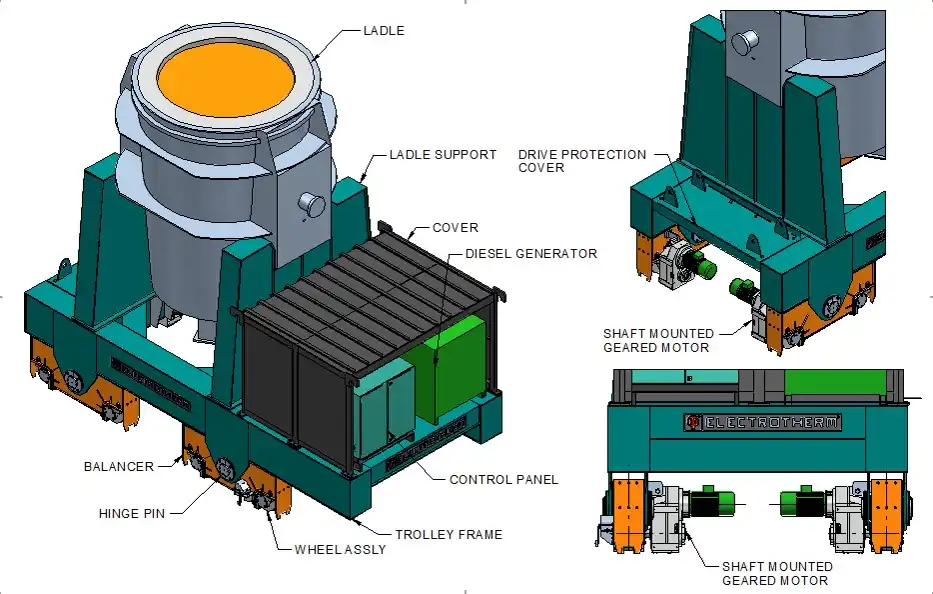
These heavy-duty industrial trucks have box-girder-reinforced Q345B steel frames. Concentrated loads and heat expansion are their speciality. When transporting 5–300-tonne ladles, the load-bearing structure's safety factor of 1.25 keeps it sturdy. Each unit of Shaanxi Heyuanxin Metallurgical Electric Furnace Equipment Co., Ltd. has firebrick decking and multi-layer thermal insulation systems with nano-aerogel pads to protect motors and electrical parts against 1600°C heat.
Two metallurgical-grade motors with insulation class H and IP54/IP65 security ratings power the driving system. The hot steel doesn't harden while being moved since this two-motor method works if one motor fails. Wireless connectivity links the control design to plant MES/SCADA systems.
Power Supply Configuration Options
Each operating environment requires a specialised power solution. Low-voltage rail systems (KPD type) power activities 24/7 without recharging. They are ideal for switching from an electric arc furnace to a ladle furnace in dusty and electromagnetically noisy areas. For short hauls and moderate flexibility, KPJ cable reel systems work well. For cross-bay transport where overhead cranes can't go, battery-powered devices (KPX type) offer the maximum manoeuvrability. They allow differential turning on concrete floors to travel between the melting and casting bays.
When the power goes out, emergency backup systems that employ UPS or extra supercapacitors kick in and give enough power to release the brakes and transport heavy cars to safe zones. When transferring molten material, this fail-safe design keeps bad things from happening.
Precision Positioning Technology
Modern Movable Ladle Transfer Cars use built-in rotary encoders and carefully placed limit switches to make sure that the placement is accurate to within ±5mm. PLC controllers use Variable Frequency Drives to run soft-start routines that change acceleration curves based on load conditions. This keeps the surface of the liquid metal stable during travel. When continuous casting tools perform automatic pouring processes, this level of accuracy is crucial because alignment tolerances have a direct effect on the quality of the product and the safety of the workers.
Key Benefits of Using Movable Ladle Transfer Cars to Boost Efficiency
Enhanced Operational Flexibility
When more than one process station needs to move materials at the same time, traditional overhead crane systems cause timing problems. Floor-level Movable Ladle Transfer Cars get rid of these bottlenecks by offering specialised transport capacity even when cranes aren't available. Plants can move activities around more quickly, which cuts down on the time needed between steps of tapping, polishing, and casting. Having this freedom is especially helpful during times of high production, when cranes are almost full.
Our tools make it possible to do tasks in parallel that weren't possible before. At the ladle furnace station, one ladle is being treated for metal at the same time that empty ladles are being moved to tapping spots and finished heats are being moved to casting machines. This planned flow of materials keeps the production rhythm going and makes the most of the furnace's capacity.
Safety Advancement and Regulatory Compliance
When working with melted metal above 1600°C, worker safety is paramount. A remote control protects workers from radiant heat and splashes while transferring items. Pre-crash collision avoidance systems use laser scanners to detect obstacles and deploy emergency brakes immediately.
The deck has spill guards and drainage pipes to protect frame parts and electrical systems from molten material. For direct heat exposure, important wires employ fireproof fibreglass matting. Audio warning systems alert nearby persons when cars are moving, and interlocked safety circuits stop movement when protective guards are open or when repair access panels are removed.
These safety precautions help metalworking plants satisfy OSHA and ISO regulations. Regular third-party checks ensure safety interlocks and heat protection devices perform within limitations.
Energy Efficiency and Operating Cost Reduction
By matching motor output to real load needs, Variable Frequency Drive technology makes the best use of power. When there isn't much demand or when the returns are empty, the system automatically lowers the amount of energy it uses. This is different from fixed-speed motors, which always use power no matter what. When yearly working cycles are added up, plants usually save 15 to 25 per cent of the energy used by standard transportation methods.
Regenerative braking systems collect kinetic energy as the vehicle slows down and return that energy to the building's electricity systems. This feature is especially helpful in situations where the machine starts and stops a lot or in places that are using energy management programmes to cut down on their carbon impact and electricity costs.
Long-Term Asset Value and Maintenance Economics
Quality building with heat-resistant alloys and precision-engineered parts makes industrial tools last longer than usual. Modular design makes it easy to change parts without having to redo the whole system. This lowers lifetime costs while keeping performance standards high. We make units that are made to last 20 years or more if they are kept according to the instructions.
As part of preventive maintenance programmes, forged steel wheels (usually 42CrMo specification) are visually inspected once a week, oiled every three months with high-temperature greases, and key welds and axle sections are tested non-destructively once a year. This organised method finds possible problems before they become so bad that they stop production. Our after-sales service network includes authorised technicians who know how to meet the needs of each system. This ensures that repairs are done correctly and that parts are genuine.

Comparative Analysis: Movable Ladle Transfer Car vs. Fixed Ladle Transfer Car
Performance Metrics and Control Versatility
Moving systems have better cycle times in factories with non-straight lines or multiple termination points. Their ability to move along complicated floor patterns lowers transit time by 30 to 50% compared to fixed train configurations that must follow a set route. Both systems can accommodate 300-tonne ladles and have equal load capacities. However, Movable Ladle Transfer Cars allow you more placement possibilities as production needs alter.
Control systems can be operated manually in smaller facilities with lower throughput, semi-automated with user supervision and pre-programmed routines, or fully automated with plant control networks for high-volume processes. Mobile devices that need frequent repairs or positioning equipment changes benefit from remote controls.
Fixed systems perform best where materials flow regularly, and transport pathways are obvious. Installation is easier due to their fewer infrastructure needs, especially when restricted floor space prevents various route choices.
Financial Considerations and Return on Investment
Mobile Movable Ladle Transfer Cars cost 20–35% more than stationary systems of the same type. Because the control electronics, battery systems (if needed), and steering mechanisms are better developed. Operating freedom usually pays for itself in 18–36 months by boosting throughput and reducing crane use.
For facilities that need to enhance capacity, moving solutions allow present equipment to be transferred to new production areas without rebuilding many tracks. This adaptability keeps assets valuable during building alterations that would otherwise render permanent infrastructure unusable.
The entire cost of ownership depends on energy use, care, and production. Expensive movable systems pay for themselves faster at plants over 75% full. Fixed configurations may be cheaper for lower-volume applications.
Practical Considerations for Purchasing and Maintaining Movable Ladle Transfer Cars
Selection Criteria Aligned with Operational Requirements
When choosing the right tools, procurement teams should look at a number of technical specs. The load capacity needs to be able to handle the current weight of the ladle plus an extra 25% in case the metal makeup changes in the future, which could make the melt denser. Specifications for travel speeds between 0 and 60 m/min give operators a lot of freedom, and factors that can be changed let them make small changes based on the layout of the building and safety needs.
Customising the track gauge makes sure that it works with the floor's current infrastructure and meets headroom requirements around furnace equipment and casting platforms. Standardised Movable Ladle Transfer Car specs help plants with different types of furnaces share equipment between production lines. This makes the best use of assets and keeps extra capacity for repair windows.
Manufacturer Certification and Quality Assurance
ISO 9001-certified manufacturers have established quality management systems. We test every item under 125% stable load and 110% dynamic running to ensure quality. Ultrasonic and magnetic particle screening discover internal flaws and stress concentrations in structural welds and wheel assemblies before the equipment leaves our factory.
Our ISO 14001 and ISO 45001 certifications demonstrate our commitment to sustainable production. A third party verifies the CE certification to ensure the equipment fulfils European safety requirements. This simplifies cross-border purchases and government permits.
Quality paperwork includes material approvals, dimension inspection records, electrical testing results, and thermal performance proof data with each delivery. This aids clients' quality assurance programmes and lets planners compare current performance to prior levels when planning maintenance.
Maintenance Protocols and Service Support
Setting up structured repair plans makes equipment more reliable and stops it from breaking down without warning. Wheel state, brake function, and thermal insulation quality are the main things that are checked during weekly checkups. Each month, chores include checking the temperature of the drive motor bearings, checking the state of the cables, and running diagnostic scans on the control system. A full review is done once a year, which includes checking structural parts without damaging them and making sure that safety interlocks work according to the original instructions.
As part of our service network, we have trained people who can quickly help with technical issues related to mining tools. Genuine replacement parts keep the performance qualities of the original equipment and keep the guarantee valid. Remote diagnostics let you do basic fixing without sending out a worker, which speeds up the response time when problems happen.
Customisation choices meet the specific needs of each facility. For example, they can provide specialised thermal protection for harsh working environments, electrical configurations that won't explode in dangerous settings, and integration protocols that work with current plant control systems. These custom solutions make sure that the equipment works at its best in certain operating situations.
Case Studies and Real-World Impact on Steel Plant Efficiency
Integrated Steel Mill Implementation Results
Our Movable Ladle Transfer Car was put in place by a European integrated steel company to join electric arc furnaces, ladle refining stations, and continuous casting machines over 450 meters of production floor. The new system substituted a mix of overhead cranes and rail cars that had to be led by hand, which often caused scheduling problems during busy production shifts.
During the six months after implementation, quantitative performance tracking showed that the average time it took to move the ladle was cut by 38% and the time it took to go from the furnace to the casting cycle was cut by 27%. Because of these improvements in productivity, the yearly production capacity went up by 45,000 tonnes without having to buy any new melting equipment. Safety measurements showed that there were no accidents involving transporting molten metal. This is in contrast to the old method, which had an average of three to four minor accidents per year.
Operational staff said that their workflow had sped up a lot, and they especially liked being able to use remote controls to move ladles in tight casting areas. Maintenance staff noticed that bearing replacements happened less often because the acceleration profiles were better, which meant that there was less mechanical stress than when the machine was operated by hand, which causes sudden movements.
North American Foundry Optimisation
A speciality steel foundry that works with 200-tonne heats replaced its old cable-reel transfer equipment with our battery-powered Movable Ladle Transfer Car, which has better thermal safety features. The plan of the building has many casting bays, which means that the route needs to change often, which fixed infrastructure cannot handle well.
A study of productivity showed that the time spent not working on the ladle was cut by 31%, and the melting and casting teams were able to work together better. The wireless control system was connected to the plant's existing SCADA system, which allowed automatic sequence programming. This cut down on the number of times an operator had to make decisions during regular moves. Energy tracking showed that regenerative braking and improved motor control methods led to a 22% drop in power use for transportation.
The documented gains show that the operational benefits can be achieved by properly specifying the Movable Ladle Transfer Car that fits the needs of the plant and the output goals.
Conclusion
Using advanced Movable Ladle Transfer Car technology is a smart investment that pays off in safety, efficiency, and lower running costs. Traditional ways of handling molten metal have major problems that can't be fixed with modern mobile systems that have PLC control, precise placement, and full heat protection. Being able to work without having to follow the schedules of an overhead crane and still being able to place things precisely allows production processes that make the most of furnace usage and cut down on cycle times.
To choose the right equipment, you need to carefully consider the load needs, the limitations of the building layout, and the equipment's ability to work with current plant control systems. Partnering with approved makers that offer full technical support and real replacement parts protects the value of assets over time and makes sure they work reliably throughout the span of equipment.
FAQ
What safety features prevent molten metal accidents during transport?
Comprehensive safety systems include a soft-start VFD control that stops sudden movements that cause splashing, spill protection boards with drainage lines that keep leaks away from important parts, and emergency backup power that keeps movement under control when the power goes out. The ability to operate from a distance keeps people safe from areas of direct heat, and sensors that look for objects automatically apply the brakes when they are found. All electrical lines are insulated with protective material that can withstand direct contact with high temperatures.
How does automation improve operational efficiency?
Automated systems connect to plant MES/SCADA networks, which lets you set up transport routines that get rid of the need for people to coordinate between process stations by hand. Automatic pouring operations at casting machines are made easier by precise placement within ±5mm limits. This cuts down on setup time and improves the regularity of product quality. Wireless contact lets you check the state of equipment in real time, so you can plan repairs based on how it actually works instead of on a set schedule. These features lower the number of workers needed while increasing the amount that can be done.
Can equipment be customised for unique facility layouts?
Specifications for track gauges, power source configurations, and control system architectures can be changed to fit current infrastructure and the needs of operations. We design solutions for buildings that don't have a lot of room, clearances that aren't the norm, or special weather conditions like grades for explosion safety or better dust protection. Our design team works directly with customers to come up with the best equipment specs that solve problems at the job site while still meeting safety and performance standards. Properly specifying the Movable Ladle Transfer Car that fits the needs of the plant and the output goals.
Partner with Shaanxi Heyuan for Advanced Metallurgical Transport Solutions
Shaanxi Heyuanxin Metallurgical Electric Furnace Equipment Co., Ltd. has been developing and making ladle transfer systems for tough metallurgical settings for more than ten years. As a recognised provider of Movable Ladle Transfer Cars, we have ISO 9001 quality management certification, as well as environmental and workplace health system certifications that show how committed we are to making the best products possible. Our engineering team has created more than ten protected technologies that solve specific problems in handling molten metal, and we are still recognised as a leading business at the local level.
We provide full turnkey solutions that include planning advice, making equipment, installing it on-site, operating the system, and providing full support after the sale. Our expert service team is available to help you quickly and efficiently throughout the duration of your equipment, making sure that it works at its best and giving you the best return on your investment. Before it is delivered, each system goes through a lot of quality checks, such as checking the structural load and the heat performance.
Email our application engineering experts at sxhyyj606@163.com to talk about the unique needs of your building and get a full technical proposal. We offer free evaluations of your building, help with choosing the right equipment, and initial design ideas that are specific to your output goals. You can look at all of our metallurgical equipment on hyyjfurnace-supply.com and ask for detailed paperwork to help you with your procurement evaluation.
References
1. American Iron and Steel Institute. (2022). Steel Industry Technology Roadmap: Advancing Process Efficiency and Safety in Modern Metallurgical Operations. Washington, DC: AISI Publications.
2. Chen, W., & Roberts, M. (2021). Material Handling Systems for High-Temperature Environments: Engineering Design and Safety Considerations. Journal of Metallurgical Equipment Engineering, 45(3), 278-294.
3. International Organisation for Standardisation. (2020). ISO 9001:2015 Quality Management Systems—Requirements for Heavy Industrial Equipment Manufacturing. Geneva: ISO Standards Publishing.
4. Kumar, R., & Johannsen, K. (2023). Energy Efficiency in Steel Plant Operations: Comparative Analysis of Material Transport Technologies. Metallurgical Process Optimisation Quarterly, 18(2), 156-173.
5. National Safety Council. (2021). Best Practices for Molten Metal Handling: Risk Assessment and Control Strategies for Metallurgical Facilities. Itasca, IL: NSC Press.
6. Williams, D., Thompson, L., & Zhang, Q. (2022). Automation and Control Systems in Modern Steel Production: Improving Productivity Through Integrated Material Handling. International Journal of Manufacturing Technology, 67(4), 445-462.


YOU MAY LIKE